Design Futures + Immersive Scenario Planning
Civic Communication, Narrative Conditions, and Trust as Infrastructure
Certification: Futures Studies and Speculative Design, Parsons School of Design / The New School
Focus: Civic communication systems, public trust, institutional memory, and future narrative design
Time Horizon: 2035
Project Type: Academic case study, futures research, scenario planning, immersive prototype
This case study documents a body of work completed through the Futures Studies and Speculative Design certificate program at Parsons School of Design / The New School.
It is also a record of the civic communication work that shaped the project.
That work began in Cleveland Heights, Ohio, during the city’s first strong-mayor administration. Cleveland Heights voters approved the shift to a strong mayor-council form of government in 2019, elected the city’s first directly elected mayor in 2021, and entered the new structure in 2022.
I served as Communications Director during that early implementation period and helped build the city’s first formal communications department within a government structure still being defined in real time.
The role required more than producing public updates. It required building communication systems while the institution itself was adapting: clarifying how information moved, how decisions were explained, how residents were informed, how media inquiries were handled, how departments coordinated, and how the public record could remain coherent through political, administrative, and operational change.
That experience became the foundation for a futures-design project about public trust, institutional memory, narrative control, and communication as infrastructure. It gave the work its central tension:
What happens when a city is not only communicating change but also building the structure that makes change understandable?
In most institutions, communication is judged by what it produces: a public update, a press release, a campaign, a statement, a website page, a social post. Those outputs matter, but they are not the whole system.
This project looks beneath the output.
It asks what communication does when it is responsible for continuity: helping people understand what happened, what changed, what is current, what was corrected, and where the record lives.
In that frame, communication becomes part of the civic structure. It carries memory. It creates access. It reduces confusion. It gives residents a way to follow decisions over time.
The work is not about making government sound better.
It is about making public information easier to trust because it is clear, traceable, and built to hold.
What This Work Documents
This case study brings together the academic work, the civic record, and the professional method that emerged from both.
It documents the futures-design process I completed through the certificate program: signal scanning, scenario planning, visual scenario development, immersive prototyping, peer feedback, and reflection.
It also preserves the Cleveland Heights communication work that informed the project. That work included public information systems, mayoral communication, city publications, resident updates, web content, media response, internal coordination, crisis communication, documentation practices, and the early development of a formal communications function under a newly implemented government structure.
The connection between the two is the real subject of the project.
Cleveland Heights gave me the working conditions. Futures studies gave me the framework. Scenario planning gave me a way to examine what happens when communication systems hold, weaken, fragment, or disappear.
This page is not only a portfolio case study. It is a record of how public communication becomes infrastructure when it is responsible for continuity, memory, access, and trust.
Cleveland Heights as the Signal Environment
Cleveland Heights became the signal environment for this project because the city was still learning what communication needed to become under its new strong-mayor form of government.
The city approved the move to a strong mayor-council structure in 2019. The first mayoral election under that structure took place in 2021, and the new system began operating in 2022.
I entered the work in 2023 as a communications vendor. At that stage, the communications function was still informal, emerging, and dependent on immediate needs: public updates, newsletters, mayoral communication, resident information, website content, media response, event materials, and project support.
By 2025, I moved into a direct role as Communications Director and continued building the city’s first formal communications department from inside the institution.
That distinction matters.
The work did not begin as a finished department with established systems, clear workflows, or settled authority. It developed over time, inside a government structure that was itself still new. Communication had to be built while the city was adapting to executive administration, changing expectations, public scrutiny, internal coordination demands, and the everyday pressure of keeping residents informed.
That is where the futures question came from.
Cleveland Heights showed me that communication is not secondary to governance. It is one of the ways governance becomes visible. When communication systems are clear, residents can follow what is happening. When they are fragmented, people are left to interpret the gaps.
Those gaps become stories.
Those stories become public memory.
This project treats Cleveland Heights as a civic communication case study. It uses the city’s transition, communication demands, institutional pressures, and public information needs as signals for a larger question about the future of trust in local government.
What does a city need to preserve? What does it need to explain? What needs to remain findable after the meeting ends, the staff changes, the headline passes, or the administration turns over?
Those questions shaped the scenario work.
The Futures Question
The project began with a practical problem I had already seen inside municipal communication.
Public trust does not break only because information is missing. It also breaks when information is scattered, delayed, inconsistent, difficult to verify, or dependent on individual people instead of durable systems.
A city can be doing the work and still lose the public story of the work.
A record can exist and still be hard to find.
An update can be published and still fail to create understanding.
A decision can be explained once and still disappear from public memory.
That gap became the center of the project.
I wanted to understand how civic communication systems might need to change by 2035 if residents are expected to trust public information across leadership change, media pressure, political conflict, infrastructure disruption, and fragmented information environments.
The working question became:
How might civic communication systems need to change by 2035 if public trust depends on information that is clear, traceable, accessible, and durable over time?
This question moved the work beyond Cleveland Heights as a single place. Cleveland Heights provided the signal environment, but the issue is larger than one city.
Local governments are being asked to communicate in conditions that are faster, more fragmented, more emotional, and more publicly scrutinized than the systems were built to handle.
The future problem is not simply how to say more.
It is how to build communication systems that can hold continuity when the institution is under pressure.
From Civic Signals to Scenario Planning
The method began with signals.
I looked at the communication conditions around Cleveland Heights and treated them as evidence of a larger civic pattern: leadership transition, public scrutiny, documentation gaps, media pressure, resident confusion, internal coordination demands, and the challenge of keeping information coherent across time.
Because I began collecting signals before I had full institutional authority, the project was shaped by observation as much as control. I was not looking back from a clean leadership position. I was working inside the system while noticing where the system itself was underbuilt.
That made the signals more useful.
They revealed the difference between producing communication and governing the conditions that make communication possible: authority, workflow, access, timing, documentation, and institutional trust.
Those signals led to two critical uncertainties.
The first was narrative control: who shapes the public story when an institution is under pressure?
The second was institutional continuity: whether knowledge remains inside the institution over time, or disappears when staff leave, administrations change, records scatter, or systems were never formally built.
Those two uncertainties became the foundation for the scenario matrix.
The matrix was not designed to predict one future. It was designed to show four possible communication conditions and make the stakes visible.
When narrative control is strong and institutional continuity is structured, public information can become clear, durable, and trusted.
When one weakens, the public record becomes harder to follow.
When both weaken, a narrative vacuum forms.
The Four Scenario Conditions
The scenario matrix produced four civic communication conditions.
Each one describes a different relationship between public narrative and institutional continuity. The point was not to predict exactly what Cleveland Heights, or any city, will become. The point was to make the consequences visible.
Owned and Recorded
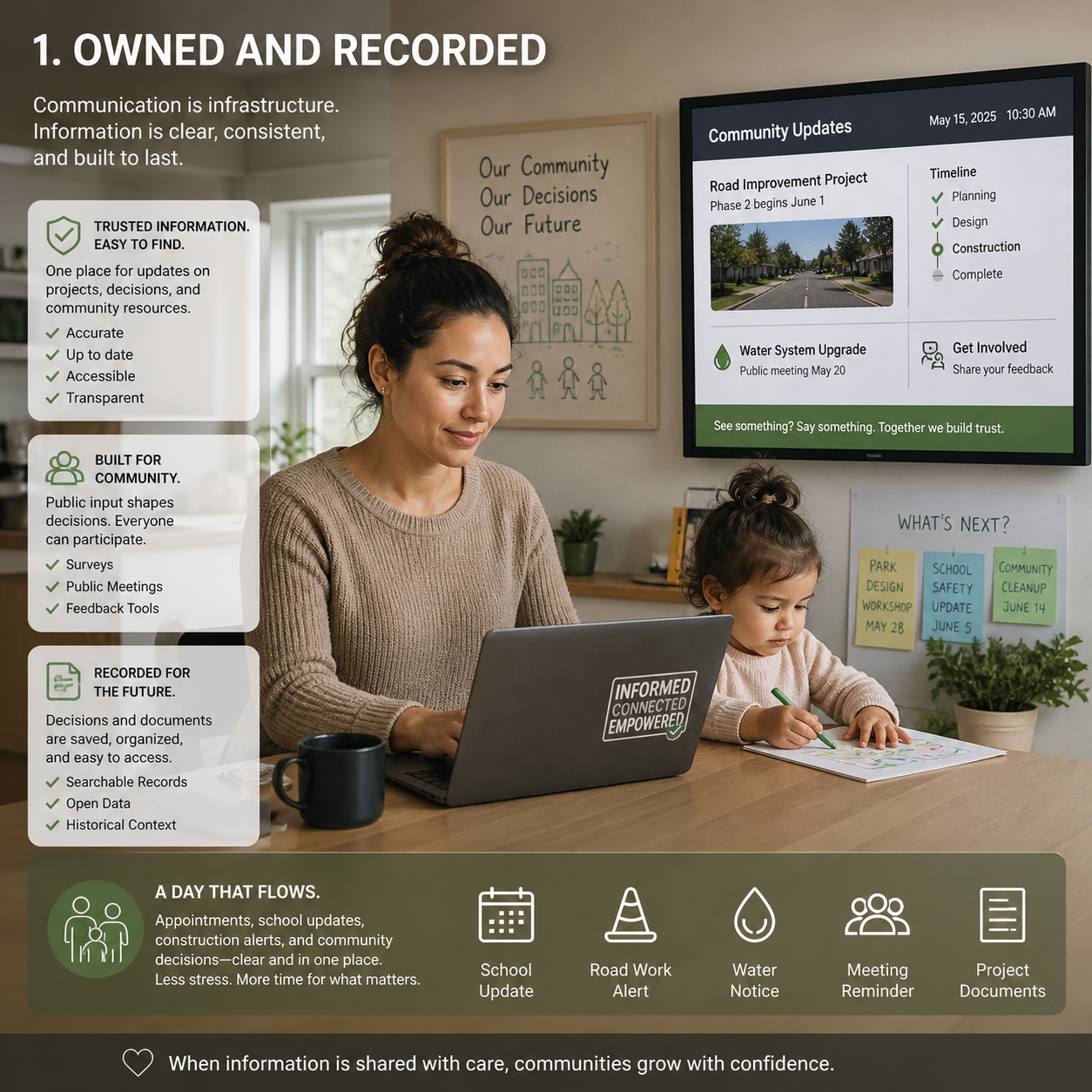
In this condition, the institution has both narrative control and structured continuity.
Public information is clear, findable, current, and connected to decisions over time. Residents know where to look. Updates are consistent. Corrections are visible. The public record holds.
This is the strongest condition because communication is not dependent on memory, personality, or improvisation. The system carries the work.
Structured but Contested
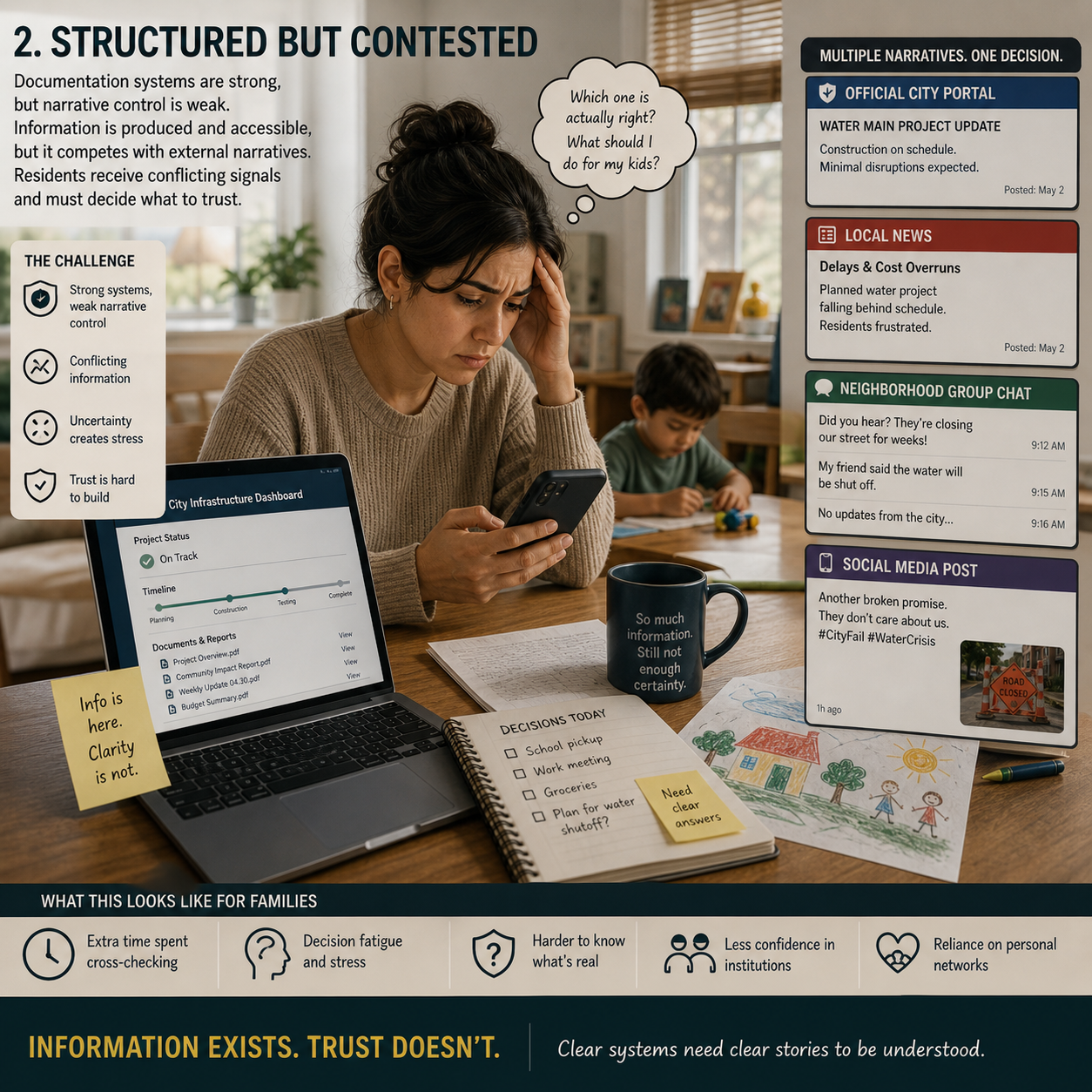
In this condition, documentation systems exist, but the public story is still shaped elsewhere.
The institution may be producing information, but residents are also receiving competing versions through media coverage, informal networks, group chats, political interpretation, and public frustration.
This scenario shows that access to information does not automatically create trust. A record can exist and still be contested if the narrative around it is unstable.
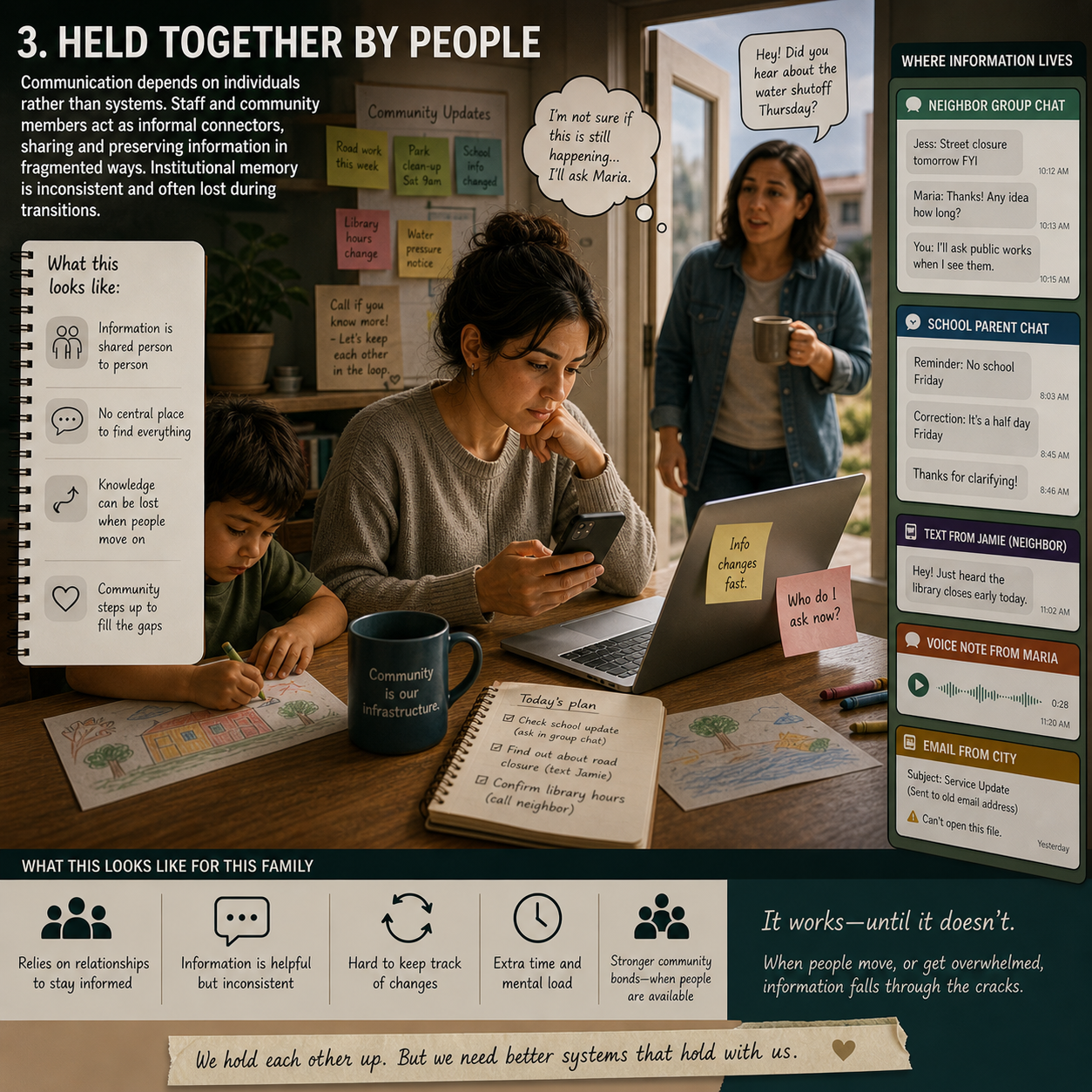
Held Together by People
In this condition, the public story has some coherence, but continuity depends on individual people instead of durable systems.
Staff, residents, community connectors, and informal messengers keep information moving through effort, memory, and relationships. The work continues, but it is fragile.
When people leave, the knowledge leaves with them.
This is not true continuity. It is strain that looks like stability from the outside.
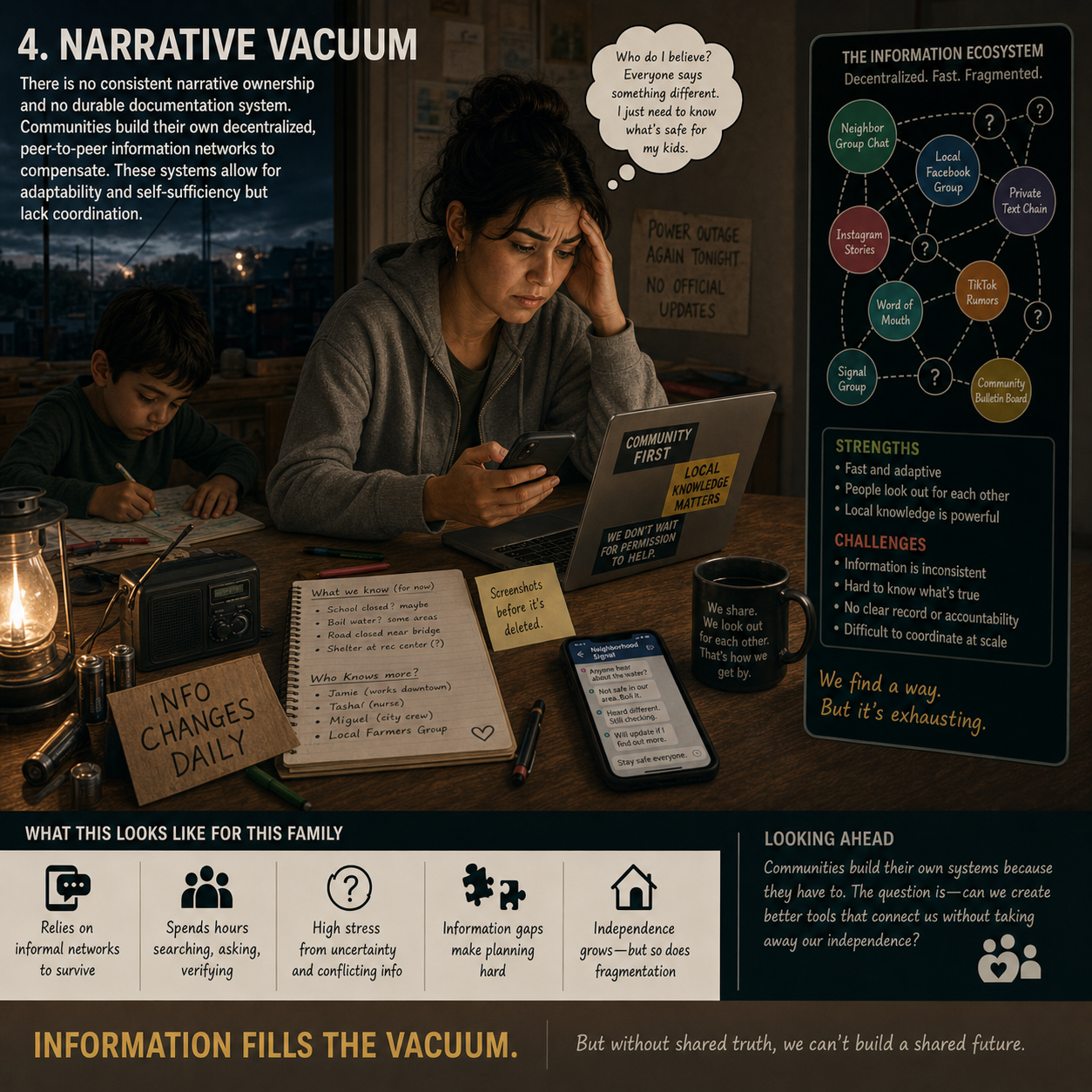
Narrative Vacuum
In this condition, both narrative control and institutional continuity are weak.
Information gaps are filled externally. Residents build their own explanations from fragments, rumors, screenshots, headlines, meeting clips, and partial records. The result is not silence. It is too many competing stories without a reliable center.
This became the most important failure state in the project.
A narrative vacuum does not stay empty. Something always fills it.
From Scenario Matrix to Immersive Prototype
The scenario matrix gave the project its structure. The immersive prototype tested whether those conditions could be felt.
I did not want the final work to live only as a planning diagram or written scenario. Civic communication is experienced through ordinary pressure: checking for updates, trying to confirm what is true, hearing conflicting accounts, searching for a record, adjusting plans, and carrying uncertainty into daily life.
The prototype focused on that experience.
It used pacing, repetition, sound, image, domestic routine, and diminishing narrative clarity to test how different information conditions affect a person’s sense of stability.
The work was intentionally modest in form. It was a first layer, not a fully developed film or finished immersive environment. I did not have the time to build the piece as far as I would have liked.
That limitation became part of the record.
The prototype shows the method in progress: moving from signals, to scenarios, to a sensory test of how narrative clarity and narrative breakdown might feel inside everyday life.
With more time, I would develop the piece further through clearer character continuity, tighter sound design, more deliberate object symbolism, stronger transitions between conditions, and additional viewer testing.
Even in its early form, the prototype helped confirm the larger argument of the project.
Public trust is not only intellectual.
It is emotional, spatial, domestic, and embodied. It affects how people move through the day.
Peer Feedback + Iteration
Peer feedback became part of the testing process.
The comments confirmed that the project’s core question was legible beyond my own framing. Viewers understood the work as an investigation into informational trust, narrative clarity, emotional pressure, and the way public systems enter ordinary life.
That mattered because the scenarios were not designed as distant future worlds. They were built around recognizable routines: checking updates, interpreting fragments, carrying uncertainty, and trying to make practical decisions when the information environment is unstable.
The feedback also clarified the next layer of development.
The strongest response was to the domestic framing and to the Narrative Vacuum scenario. That scenario made the failure state clearest: when no durable record holds and no trusted narrative center exists, people are not left with nothing. They are left with too much to sort through.
The critique also showed where the immersive prototype needed to go further. A fuller version would need a clearer character thread, stronger object symbolism, more deliberate pacing, and a sharper relationship between the four scenario conditions and the film form.
That feedback helped define the prototype accurately.
It was not a finished immersive environment.
It was a first test of whether civic communication conditions could be translated into feeling, rhythm, and atmosphere.