Is Advertising in Its Mean Girl Era? Not Quite.
The Good Good/Callaway debacle is a cautionary tale about what happens when creative ambition outruns nuance.
I don’t have much time for television, and even less for commercials. I’d heard about the Good Good/Callaway issue, but honestly, I didn’t give it much thought. Then, over a weekend out of town, I was staying at a hotel and saw something that triggered my spidey senses—or, rather, flexed my futurist muscles.
It was a fifteen-second Chase Freedom Unlimited commercial called “Soccer Fever.” A woman reaches the counter and, before anyone can help her, a man barrels in ahead of her and asks for lozenges. It is a tiny joke inside the larger soccer-fever premise. He is so excited that, apparently, she no longer exists, and neither does the fact that she was standing there for exactly the same reason.
It bothered me enough that I went online to make sure I wasn’t manufacturing outrage over something I had misread. Unfortunately, there it was. I saw what I saw.
I am not particularly precious about commercials. I am a creative director. I have goth leanings (see, Mom? It wasn’t a phase). I understand humor in all of its incarnations, including the occasional creative decision whose entire purpose is to make you say, What the hell did I just watch? I am a huge fan of artistic risks. I genuinely believe challenging an audience is a sign of respect, and I would like to see more of it.
What bothered me about the Chase spot was how unnecessary the violation was to the story. Nobody has to explain why cutting in front of someone is rude. We understand it instantly, but it didn’t add anything; the commercial was already funny. I understand advertising needs to be efficient, where fifteen seconds now has to establish a premise, introduce a product, create some kind of emotional response, and get out before you look away. But the dash of racialized misogyny wasn’t necessary for the chef’s kiss.
The internet figured out years ago that irritation is an extraordinarily efficient way to make people participate. Bots know it. Content farms know it. Influencers know it. Advertising was always going to learn the same lesson. Someone makes a cooking video and does something completely wild, gross, and obviously wrong, like washing shredded cheese or cutting food with ridiculous scissors. Not scraping the bowl is a personal peeve I’ve learned to just black out. The possibilities for irritating strangers are endless, and the comments are explosive.
Why would you do it like that?
That is disgusting.
You could have just—
That is the product. You give them a view; they take your energy, even if all you do is read the comments. I have absolutely “come here just for the comments” myself.
Being mean isn’t only daring; it’s efficient. That is what made me think about Good Good again.
Then I actually watched the ad
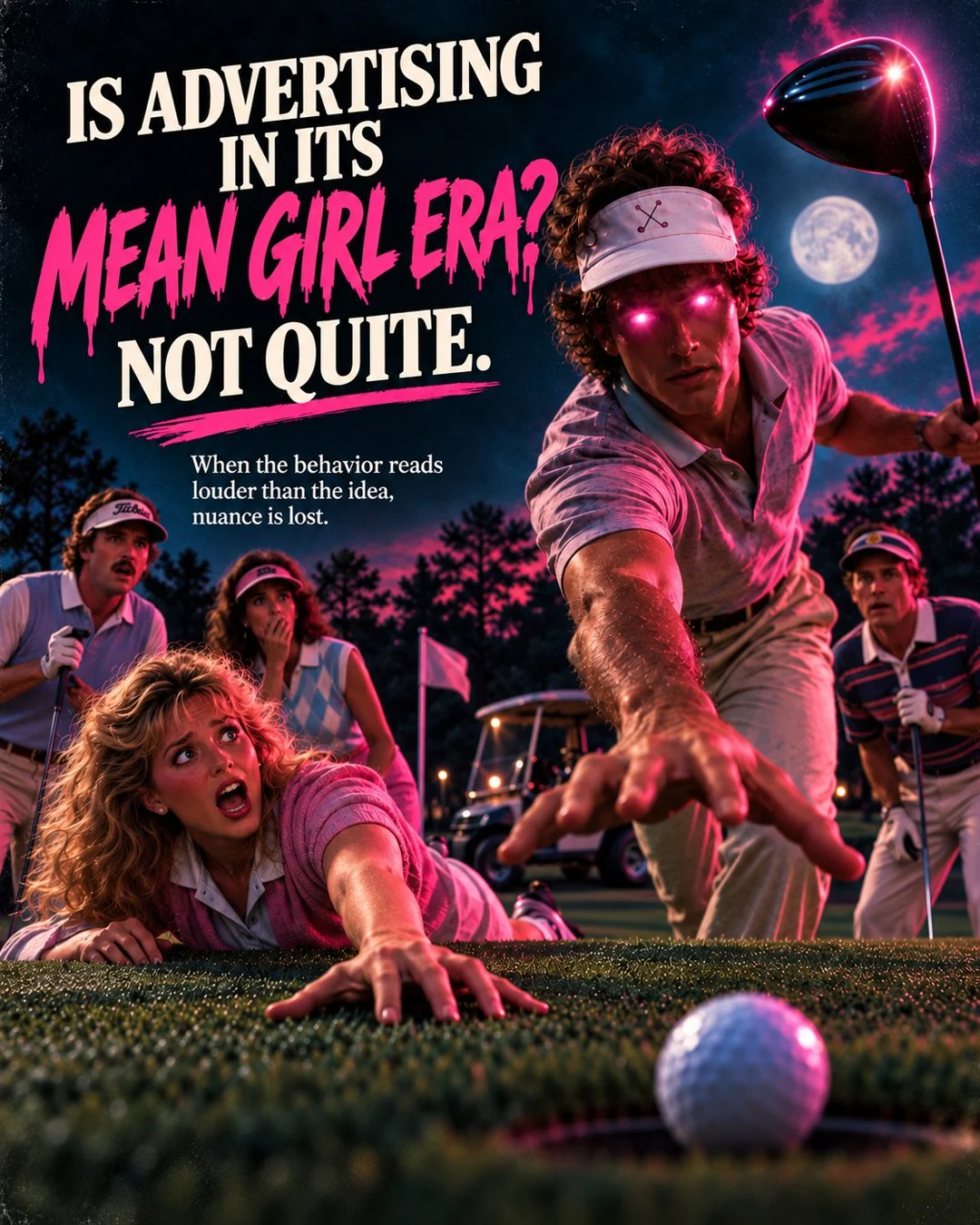
I had assumed the Good Good commercial was simply an uglier example of the same thing. Then I watched it and realized it was a good idea, poorly executed. The ad is a micro-horror movie where the driver possesses the golfer.
That is it. That is the whole thing. The golfer is so consumed by the club that it effectively takes control of him. Once you see the spot through that lens, the creative logic is obvious: possession, obsession, menace, absurdity. I am certain the pitch sounded fantastic. I might have liked it in the room.
The execution does not make the horror premise stronger than the aggression. If you do not immediately understand that the character is effectively possessed, the part that remains perfectly clear is a man knocking a woman to the ground over a golf club. The concept is still there, but the behavior overwhelms it.
That changed the article I thought I was writing.
This is not really a story about advertising getting meaner. It is a cautionary tale about ambition and nuance. The more culturally loaded the creative device, the more disciplined the execution has to be. If you are going to work with aggression, humiliation, horror, politics, sex, race, grief, or anything else that arrives with meaning already attached to it, you have less room to be vague about what the audience is supposed to understand.
You want Son of a bitch, they actually pulled it off. You do not want yikes.
That difference can be very small on paper and enormous once you send your creation into the world.
The Audience Wasn’t There
Branded content does not materialize fully formed onto someone’s phone. There are meetings (so many meetings) followed by scripts, shoots, edits, reviews, approvals, and people whose jobs involve protecting the brand. Callaway has acknowledged that Good Good produced the spot and Callaway approved it before it was posted.
Everyone involved in making that commercial had context that the audience did not have.
They knew the premise. They knew the horror logic. They knew what the actor was supposed to be communicating. They knew what had been discussed before the shoot and what the finished edit was supposed to communicate.
The audience got fifteen seconds. This is the problem: everyone inside a process can understand an idea so completely that it becomes difficult to remember what the work looks like without all the information they are carrying around in their heads.
That is also why this is more interesting than simply a bad idea. Bad ideas are easy. I have them all the time. You have them too. Creative people probably have more than most because generating ideas is literally the job. All those eternal meetings are supposed to catch the obvious failures.
The harder problem to spot is the good idea that survives every meeting, every edit, and every approval, only to fall apart when it reaches the audience.
Advertising can now measure almost everything about a piece of work: views, completion rates, shares, comments, recall, search behavior, engagement. What those systems still cannot do for you is decide whether the audience actually saw what you thought you made, or whether the attention you earned was worth the way you earned it. That remains a human responsibility.
So, er….take the swing
I do not want the lesson from Good Good to be that brands should retreat into a beige creative bunker where attractive people politely hold products and nobody risks offending anyone.
Please, God, no.
Audiences are more genre-literate than they have ever been. Adult Swim, Interdimensional Cable (IYKYK), horror-comedy, reality television, internet absurdism, antiheroes, nihilism, and decades of deliberately uncomfortable entertainment have given creatives a huge vocabulary to work with. Use it. Be strange. Be dark. Make something ambitious enough that the audience has to catch up with you.
But ambitious work carries a higher burden. Advertising does not get a director’s commentary afterward. It gets a few seconds to establish the world, communicate the genre, make the joke, sell the product, and somehow leave the brand intact.
When that works, it is brilliant.
When it does not, the audience is left with whatever was easiest to understand.
That is the cautionary tale here.
Take the swing. Just make sure audiences understand the nuance.
The goal is brilliant, bravo. Not yikes.
