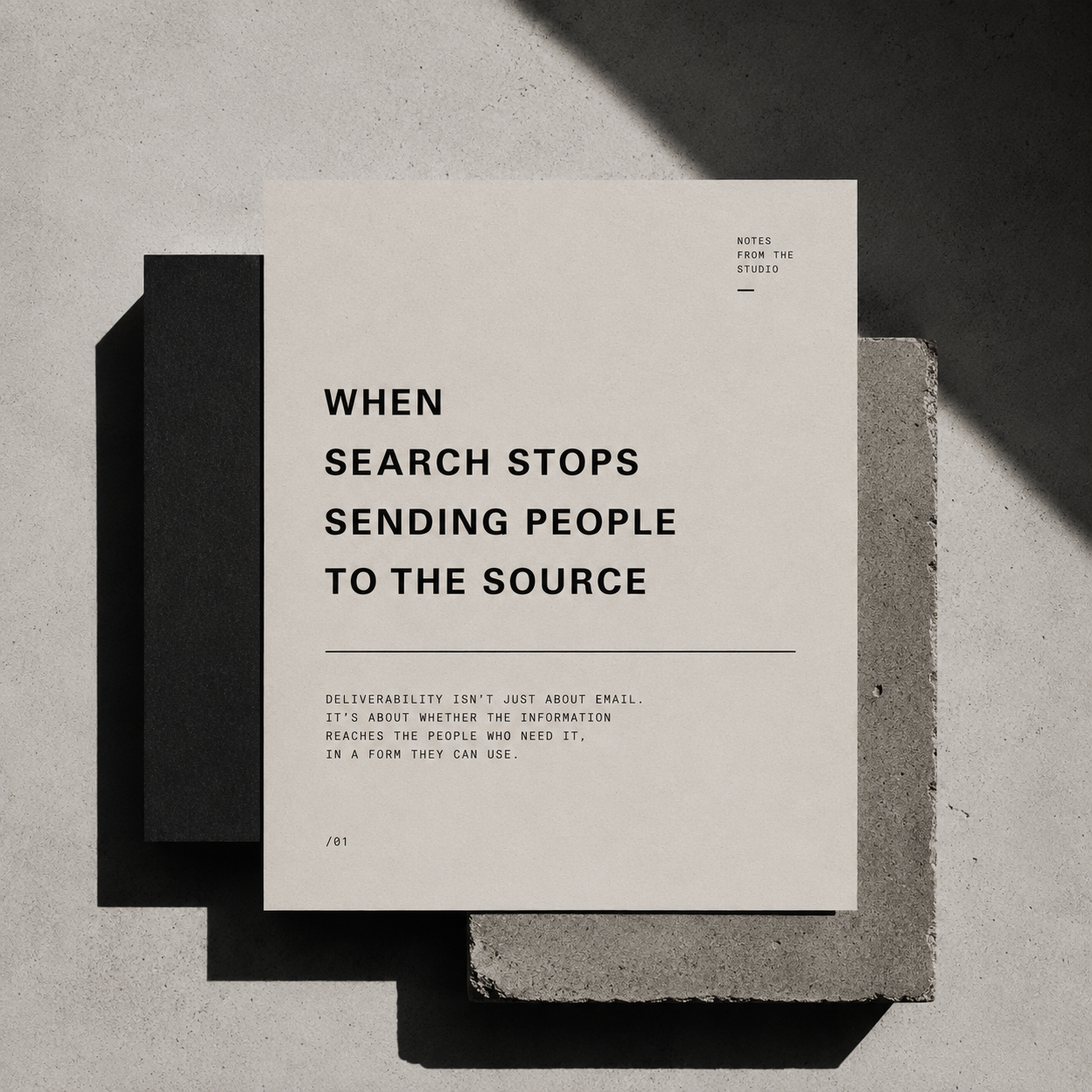
When Search Stops Sending People to the Source
For years, we built websites as if people would land on the homepage, politely click through the menu, choose the correct page, and read everything in order like a well-behaved guest at a dinner party.
I am not sure people ever behaved that way, but they certainly do not now.
People arrive from everywhere. They come through search results, forwarded emails, social posts, screenshots, text messages, links somebody dropped into a group chat, and explanations they only half remember hearing somewhere else. They may encounter a headline before they encounter the organization. They may see three sentences pulled from a page without ever seeing the page itself.
Increasingly, they may also get an answer without visiting the source at all.
Search engines summarize. AI systems answer questions. Social platforms generate previews. Someone screenshots the important paragraph and sends that instead of the link. Information that once depended on a person visiting your website now travels well beyond it.
That changes what we should expect from public communication.
The old question was often whether the information had been published. Is it on the website? Did the email go out? Did we post it to Facebook?
Those are useful production questions. They are not particularly good measures of whether communication worked.
Email has a term that helps explain the difference: deliverability. Technically, it refers to whether an email successfully reaches an inbox rather than being rejected or filtered. I think there is a useful larger question inside that idea for public communicators.
Did the information actually reach the people who needed it, in a form they could understand and use?
Because you can absolutely publish something and still fail to deliver it.
The answer can exist on the website while being nearly impossible to find. A social post can attract attention and then send people to a page that does not answer the obvious next question. A newsletter can go out exactly on schedule while missing many of the people most affected by the information.
The problem is not necessarily the writing. Sometimes the information itself is perfectly good.
The system around it is not.
This matters more as search becomes less dependent on sending people back to the original source. For a long time, organizations could reasonably assume that search was part of the pathway to their website. Someone asked a question, saw a result, clicked, and encountered the information in the environment where the organization had published it.
That pathway is no longer guaranteed.
An answer may now be assembled from several sources. A paragraph may appear in a preview. Old information may surface beside new information. A press release may become more searchable than the page explaining what eventually happened. A PDF uploaded five years ago can remain remarkably persistent long after everyone inside the organization has forgotten it exists.
Search is very good at exposing the debris organizations leave behind.
An unclear page title, a missing date, an update buried several clicks deep, an abandoned FAQ, an old PDF, or a department page containing almost no useful information can sit quietly for years until somebody asks exactly the question that causes it to surface.
Then, suddenly, that old piece of information is part of the public explanation again.
This is why publishing has to include some thinking about what happens afterward.
Where does the authoritative version live? If something changes, will that page be updated? Is there an obvious date? Can someone tell whether the information is current? Are older versions removed, archived, or clearly labeled? Do the email, social post, printed notice, and website all point toward the same underlying information?
These are distribution questions, but they are also information-management questions.
And they should be considered before something is published, not after somebody discovers that three different versions are circulating.
Public organizations are especially vulnerable to this because their information has a long life and a broad audience. Residents search for information when something affects them directly: a road closure, tax deadline, public meeting, recreation program, utility problem, election, permit requirement, construction project, policy change, or service interruption.
They are usually not interested in exploring the organization.
They have a question.
Who is affected? What changed? When does it happen? What am I supposed to do? Is this still current? Is what somebody told me actually true?
The page they reach should respect that.
A clear title matters. So does a date. The opening paragraph should tell someone what happened and who needs to care. Headings should correspond to the questions a person is likely to ask rather than the internal structure of the department that wrote the page.
And the page should not assume that calling the office is an adequate substitute for publishing usable information.
There are plenty of reasons somebody may not call. They may be working during office hours. They may be caregiving. They may have difficulty hearing or processing information over the phone. English may not be their first language. They may simply need to understand something at 10:30 at night, when nobody is answering anyway.
There is another practical problem with relying on one-to-one explanations: every phone call creates another opportunity for the answer to change slightly.
Good public information reduces that dependence. It gives staff and residents somewhere to point and say, this is the current information.
That source becomes even more important when information is being summarized elsewhere.
If a search engine, AI system, journalist, resident, neighborhood group, or social account is going to condense what an organization says, the original material needs to contain enough context to survive some condensation.
That does not mean every page needs to become enormous.
It means the important facts cannot depend on somebody reading seven other things first.
The same principle applies across channels, although each channel has a different job.
The website is usually the best place for the complete and current version. Email can reach people who are not checking social media that day. Social media can signal that something has happened and direct attention toward fuller information. Print still matters, particularly when the audience cannot reasonably be assumed to be online.
Search is different. Search meets people when they are already looking for an answer.
You do not completely control what it shows them.
That makes consistency across everything else more important.
If the website says one thing, an old PDF says another, the social post lacks context, and the newsletter links to a page that has since moved, the public is left to reconcile the organization's information for itself.
That is work the organization should have done.
This is also why I do not think the answer is simply producing more content.
More posts, more newsletters, more FAQs, and more pages can make an already disorganized information system worse.
The useful questions are more basic.
Where does the official information live? What needs to be repeated? What changes often enough that somebody needs to own the update? What should disappear when it expires? What does a person need to understand if they encounter only the headline and first paragraph? Where will they land if a friend forwards the email six weeks later?
Those decisions create the structure underneath the communications.
Organizations that get this right are not just better at writing. They are better at managing information.
Their websites answer questions instead of merely describing departments. Their email lists reach identifiable audiences rather than existing as one giant database. Their social channels point somewhere useful. Their archives distinguish historical information from current instruction. When something changes, there is a process for changing the source instead of adding another contradictory update somewhere else.
That is increasingly important because an organization's communication no longer stays where it was published.
It gets searched, summarized, forwarded, screenshotted, quoted, translated, clipped, and repeated. Sometimes accurately. Sometimes not.
We cannot control every version that travels.
We can control the condition of the source it travels from.
So I think the better question for public communicators is no longer simply, Did we say it?
It is: Could the people who needed this information actually find it, understand it, and know that it was current?
That is a considerably higher bar than publishing.
It is also much closer to the work.
