Bots, Traffic, and Small Studio SEO: How to Read Your Web Analytics Without Panicking
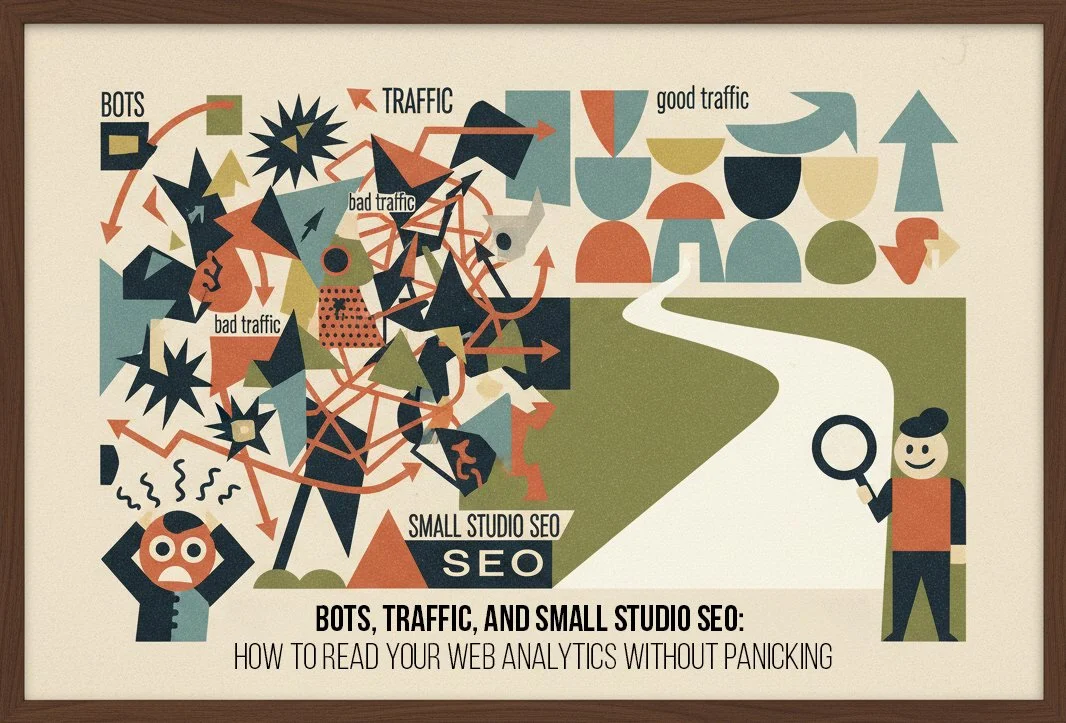
If you’re a small studio, freelancer, or micro-business owner, there’s a specific kind of dread that comes from opening your analytics and seeing… chaos.
Traffic from countries you don’t serve
Spikes at 2:37 a.m.
“Direct” traffic jumping for no obvious reason.
People landing on one page and “leaving” immediately.
Around Black Friday and Cyber Monday, this gets even louder. It can feel like something is wrong, hacked, or out of control.
Most of the time, it isn’t.
Most of the time, you’re just seeing bots.
What Bot Traffic Actually Is (and How Big It Really Is)
Bots are automated programs that visit websites. Some are helpful (search engine crawlers). Some are neutral (link preview bots). Some are malicious (scrapers, credential-stuffing tools, spam).
Recent industry reports show:
Automated traffic now makes up roughly half of all internet traffic.
“Bad bots” alone account for around one-third of all traffic, and their share has been rising year over year.
In the last year, automated traffic slightly surpassed human traffic for the first time in about a decade.
That means about half of what your analytics records are not people at all.
For small businesses, this distortion is more visible because your overall traffic volume is lower. A bot surge of a few hundred visits barely registers for a giant retailer — but on a small studio site, it looks like a “huge spike.”
Why Black Friday & Cyber Monday Make It Worse for Small Businesses
Black Friday and Cyber Monday don’t just increase shopping; they increase all traffic.
Some patterns that show up consistently:
Black Friday web traffic is often 50% or more above typical levels, with Cyber Monday close behind.
U.S. online Black Friday sales are now around $10–11 billion in a single day, with global sales estimated at more than $70 billion.
Platforms that power small and mid-sized merchants report record sales and record traffic across tens of thousands of stores.
When everyone is promoting, discounting, and sending emails at once:
Security tools ramp up automated scanning and fraud checks.
Email services auto-check links before humans even open messages.
Retail bots and scrapers crawl prices, product pages, and promotions.
From your point of view as a small business, this means:
Sudden traffic from countries you don’t serve
Sharp, short-lived spikes
A lot of “direct” or “unknown” traffic that didn’t come from any obvious campaign
It’s not that your brand suddenly went viral in an unexpected way. It’s that your site is now part of the global holiday-shopping infrastructure — whether you asked for it or not.
How to Tell If a Spike Is Real or Just Bots
When your dashboard looks wild, walk through this quick checklist.
1. Look at the timing
Bot-heavy traffic often:
Clusters in short bursts
Hits at odd hours (middle of the night, exact minute intervals)
Shows sharp spikes rather than a gradual build and taper
Real human interest usually looks more spread out and aligned with waking and working hours.
2. Look at behavior
Bots tend to:
Hit a single page
Show 0–1 seconds on the site.
Not scroll or click
Not return
Humans tend to:
Visit multiple pages
Spend at least some time reading.
Click through navigation, products, or posts.
If you open a session report and see hundreds of visits with one pageview and essentially zero time, that’s automated.
3. Look at the source
Suspicious patterns might include:
Large amounts of “direct” traffic, even though you didn’t share a URL anywhere
“Unknown” referrers or missing referrer data during periods of intense retail activity
Traffic that doesn’t line up with your email sends, social posts, or paid campaigns
That doesn’t automatically mean something is wrong — it usually just means you’re seeing background noise.
4. Look at the location and the device
Bots often:
Come from unexpected regions that don’t match your audience.
Use outdated browsers or strange combinations (for example, “mobile” identifiers with desktop-style behavior)
Have odd or impossible screen resolutions
One session like that is nothing. Hundreds of them in a wave? That’s bot behavior, not a surprise fan base.
How Black Friday Noise Shows Up in Small Studio Dashboards
Around Black Friday and Cyber Monday, you might notice:
Short-lived surges in traffic that don’t match your marketing activity
No corresponding increase in email signups, inquiries, cart additions, or sales
Higher traffic but flat conversions
This isn’t necessarily a conversion problem. It’s often a measurement problem:
Total traffic went up, but human traffic didn’t go up by the same amount.
A larger share of what your analytics measured was automated.
From a small-business perspective, this can feel discouraging — “we had all this traffic and nobody bought anything.” In reality, you may have had about the same number of humans as usual, plus a big wave of noise layered on top.
A Simpler Way to Read Your Analytics (Without Spiraling)
Instead of obsessing over every spike, build a calmer, more realistic way of reading your data.
Focus on:
1. A small set of metrics
For most small studios, that’s:
Realistic unique visitors (over time, not day-to-day drama)
Top pages
Time on site or other engagement indicators
Key actions (form fills, cart adds, downloads, inquiries)
2. Trends, not moments
Ask:
“What’s this month vs. last month?”
“What’s this holiday season vs. last holiday season?”
That smooths out the bot noise and focuses on actual patterns.
3. Cause and effect you can see
Match your numbers to real actions:
You publish a blog → do related pages see a bump?
You send an email → do you see traffic from that email’s tracking?
You launch an offer → do you see clicks and conversions from that channel?
If there’s a huge spike and nothing in your real-world activity lines up with it, that’s your sign: you’re probably looking at automation, not sudden human interest.
The Bottom Line for Small Studios
Bots aren’t going away. The trend is moving in the opposite direction:
Automated traffic is now at least half of all web traffic globally.
Bad bots alone account for around a third of all traffic.
Holiday periods like Black Friday and Cyber Monday bring even more automation, more scanning, and more noise for everyone — big brands and tiny studios alike.
So if your analytics look strange this season, it doesn’t automatically mean:
Your marketing is broken
Your audience disappeared
Or your site is under attack
It often just means you’re seeing the side effects of a loud, automated internet.
Your job isn’t to control all of that.
Your job is to understand it enough that you can keep your focus on what matters:
Are real people still finding you?
Can they understand what you do?
Can they take the next step easily?
Everything else is background noise.